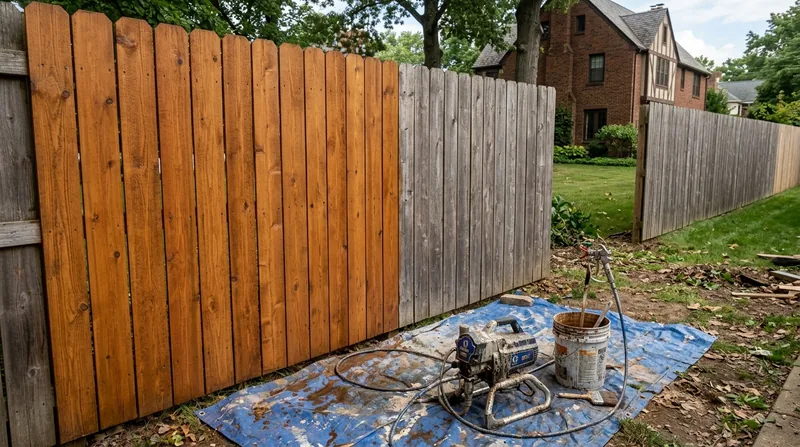




Wood privacy fences across Cleveland face constant wear from humid summers and freeze-thaw cycles that break down protective finishes year after year. Fence staining in Cleveland restores that protection, extending the life of cedar and pressure-treated pine while keeping your yard looking finished and maintained. Unlike replacement, which costs thousands of linear feet, restaining costs a fraction of that and keeps the fence you already have standing strong. We clean, sand, and reseal your existing fence so it weathers another season without rot, splintering, or gray weathering that signals the wood is failing. Most homeowners in Cleveland Heights, Lakewood, Shaker Heights, and Parma find that restaining every few years beats watching a fence deteriorate into a repair job. This page covers what the work involves, what drives the cost, and how to know when your fence is ready for restoration.
Why Fence Staining Matters in Cleveland: Protecting Wood from Weather Damage
Wood fences in the Greater Cleveland area take a beating from moisture, temperature swings, and UV exposure. Cedar and pressure-treated pine hold up well when sealed, but once the stain or sealer wears thin, water soaks into the grain and accelerates rot at the post base and rail joints. A fence that looks solid on the surface may be soft and compromised underneath. Restaining catches the fence before that damage takes hold, saving you the cost of replacing rotted posts or entire sections down the road.
- We inspect the fence for soft spots, rot, and loose fasteners before we recommend any work.
- Pressure washing removes dirt, algae, and loose finish so the new stain bonds properly to the wood.
- Sanding smooths the surface and opens the grain so sealer penetrates evenly and lasts longer.
- We apply a quality exterior stain or sealer rated for the freeze-thaw cycle that wood faces in Ohio.
- A properly sealed fence resists moisture, slows UV damage, and keeps the wood from graying or splintering.
Getting ahead of weathering costs far less than waiting for rot to set in.
Key info: A fence that has grayed or shows water staining is still salvageable with restaining. Once wood becomes soft or shows visible rot at the base or rail ends, that section needs replacement. Call us to assess what you have and what makes sense to restore versus repair.
How Fence Staining & Restoration Works: Our Process in Cleveland
We follow a proven sequence that ensures the new finish bonds well and lasts. The work takes place over two to three days depending on fence length and condition. We start by inspecting the entire fence line, identifying soft wood or damage that needs attention before staining begins. Then we pressure wash, sand, treat any problem areas, and apply stain or sealer in coats that match the wood species and your preference for color.
- We walk the fence line to spot rot, loose boards, and fasteners that need tightening or replacement.
- Pressure washing at a controlled PSI removes surface dirt and old finish without gouging the wood.
- We sand by hand or machine to feather edges and smooth the surface for even stain absorption.
- Any rotted wood is cut out and patched or that board is replaced so the stain has sound substrate to seal.
- We apply stain or sealer in thin, even coats, allowing proper drying time between coats for adhesion.
- We protect landscaping and structures during the process and clean up all debris when finished.
The entire process protects the wood and delivers a finished appearance that lasts years before another coat is needed.
Example: A homeowner in Parma with a 6-year-old cedar privacy fence saw gray weathering and soft spots in two rails. We pressure-washed, sanded, replaced the soft rails, and applied two coats of cedar-toned exterior stain. The fence now looks new and is protected for another 4 to 5 years. If that fence had been left untreated, the rot would have spread to the posts, and replacement would have cost $8,000 to $12,000 instead of $2,400 for restaining and two new rails.
See our fence repair page for guidance on when repair makes sense versus full restoration.
Staining Methods: Choosing the Right Approach for Your Fence
Not every fence needs the same treatment. The method depends on the wood species, the current finish condition, and whether you want a transparent stain that shows wood grain or a solid color that covers it. We discuss options during the free estimate and recommend the approach that gives you the longest protection and the look you want.
| Approach | Description | Best for |
|---|---|---|
| Transparent stain | Lets wood grain show through, highlights the natural color of cedar or pine, requires recoating every 2 to 3 years | Cedar fences where you want the wood character visible |
| Semi-solid stain | Covers most grain but shows some texture, provides stronger UV protection than transparent, lasts 3 to 4 years | Pressure-treated pine or cedar that has faded or shows mineral streaks |
| Solid stain or paint | Opaque finish that covers the wood entirely, offers maximum UV and moisture protection, lasts 4 to 5 years | Fences that have been painted, or where you want a uniform color regardless of wood variation |
| Clear sealer only | No color, protects wood from water and UV without changing appearance, lasts 2 to 3 years, requires frequent recoating | Recently installed or restored fences where the wood is new or recently sanded |
We stock or source finishes rated for Ohio weather and apply them in conditions that ensure proper cure and adhesion.
Fence Staining & Restoration Cost in Cleveland: What to Expect
The cost of fence staining in Cleveland depends on the length and height of the fence, the current condition of the wood, and the stain product you choose. A straightforward restaining job on a well-maintained fence starts at around $950 for a small section or shorter run. Larger fences, fences with significant rot or damage requiring board replacement, and premium stain products move the cost higher. Most residential jobs in the Cleveland area fall between $1,200 and $3,500 depending on linear footage and prep work needed.
Factors that affect the final cost include fence length in linear feet, fence height (taller fences require more labor and material), current finish condition (heavy weathering or loose old stain requires more sanding and pressure washing), wood species (cedar costs more to stain than pressure-treated pine), and whether boards need replacement. We always recommend getting 2 to 3 estimates so you understand the range and what each contractor includes. A low estimate that skips pressure washing or sanding will not produce a finish that lasts, so the cheapest quote is often the worst value.
Call us at (216) 483-2628 for a free estimate, or visit our pricing page for a detailed breakdown of what different fence types and conditions cost to restore.
Fence Staining & Restoration Near Me: What to Look for When Hiring in Cleveland
Choosing the right contractor for fence staining makes the difference between a finish that lasts 5 years and one that fails in 2. Look for a contractor who is fully insured with general liability and workers' compensation cover, can provide a certificate of insurance on request, and has verifiable experience with the wood species and finish type you need. In Ohio, fence installation and restoration work does not require a state contractor license, though some cities may have local contractor registration requirements. Always verify permit rules with your local building department and any HOA architectural guidelines before work begins. Get written estimates from at least two contractors so you can compare what is included, timeline, and cost.
- Ask the contractor for references from recent fence staining jobs in Cleveland or nearby communities.
- Confirm that the estimate includes pressure washing, sanding, any necessary board replacement, and the number of stain coats.
- Verify that the contractor carries general liability and workers' compensation insurance and can provide a certificate.
- Discuss the stain product, color options, and expected longevity so you understand what you are paying for.
- Confirm the timeline and whether the contractor can complete the work in your preferred timeframe.
- Check that the contractor understands local permit and HOA rules if your fence is in a master-planned community.
We are an AFA Member Installer and have been restoring fences in Cleveland since 2015. Call us at (216) 483-2628 or visit our contact page to schedule a free estimate with no obligation.
Fence Staining & Restoration in Cleveland: Pricing Guide
| Service | Price | Details |
|---|---|---|
| Small fence section restaining | Starting at $950 | Pressure wash, sand, and single-coat stain for up to 100 linear feet of standard-height privacy fence |
| Full residential privacy fence restaining | Starting at $1,800 | Complete process including pressure wash, sand, two stain coats, and minor board repairs for 200 to 300 linear feet |
| Restaining with board replacement | Starting at $2,400 | Full staining plus replacement of rotted or damaged boards, fastener tightening, and structural repair before finishing |
| Large fence or heavy restoration | On estimate | Fences over 400 linear feet, multiple damaged sections, or specialty finishes require on-site inspection to quote accurately |
| Estimate | Free | We inspect the fence, discuss options and timeline, and provide a written estimate with no obligation to book |
Indicative pricing, the exact cost depends on square footage, finish, and site access. Free personalized estimate within 24h at (216) 483-2628.


