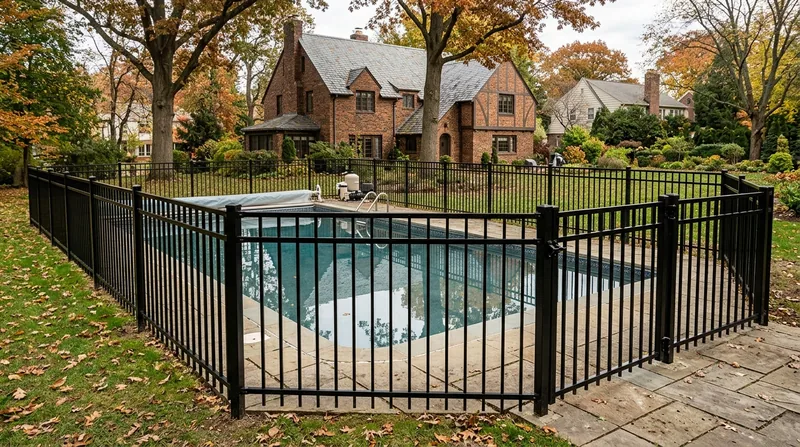




Pool fence installation in Cleveland requires more than a perimeter of boards and posts. On Cleveland's East Side and across the broader metro, homeowners with pools face specific code requirements that govern height, gap spacing, gate operation, and post depth. A pool barrier must perform reliably in freeze-thaw cycles and variable soil conditions across neighborhoods from Shaker Heights to Westlake. We set posts below the frost line, keep gaps narrow to meet code, and hang gates to swing away from the water with hardware that latches above a child's reach. Since 2015, we have installed and repaired pool fencing across Greater Cleveland to meet the codes that protect families and satisfy inspectors.
Why Pool Barrier Code Matters in Cleveland
A pool fence is not optional where a pool exists. Ohio law and local code set specific requirements for any residential pool, whether in-ground or above-ground, and those rules are enforced at the time of installation and at inspection. The barrier must be four feet tall, measured from the ground on the pool side. Gaps between vertical pickets or mesh must not exceed four inches. Gates must be self-closing and self-latching, with the latch positioned above reach. Posts must be set in concrete below the frost line to prevent heave and settling that could compromise the barrier.
- We verify local code requirements with your city or county building department before we measure and quote.
- We set posts deep enough to stay below the frost line and prevent frost heave that weakens the fence.
- We install mesh, vinyl, or aluminum barriers that meet the four-inch gap standard and keep spacing consistent.
- We hang self-closing gates with hardware rated for pool use and position latches above the reach of small children.
- We coordinate with the authority having jurisdiction to ensure your barrier passes final inspection.
Code compliance is not a suggestion. A pool barrier that fails inspection cannot be used, and repairs or replacement can be costly and urgent.
Key info: Pool barrier requirements in Ohio are set by state law and enforced locally. Your city or county building department can provide the exact code that applies at your address. We install to meet those local pool barrier codes, with final determination resting with the authority having jurisdiction. For details on Cleveland's specific requirements, contact the Cleveland Department of Building and Housing at their permit desk or visit clevelandohio.gov.
How We Install Pool Fencing in Cleveland
Pool fence installation follows a deliberate sequence. We start by confirming code requirements with your local building department, then we mark the fence line and call 811 for a utility locate (required by Ohio law before digging). We set posts in concrete below the frost line, space them to accommodate the barrier material, and hang the gate last so it operates freely and latches reliably. Every step is measured to meet code and to give you a barrier that will not shift, sag, or fail.
- We contact your local building department to confirm pool barrier code and setback rules that apply at your address.
- We request an 811 utility locate to identify buried lines before we dig any post hole.
- We mark the fence line from the survey or property corners you identify, and we set posts in concrete below the frost line.
- We install mesh, vinyl, or aluminum barrier material and maintain gaps within code limits across the entire perimeter.
- We hang the gate last with self-closing and self-latching hardware, and we test operation to confirm it swings away from the pool and latches above reach.
- We coordinate with your building department for a final inspection before you use the pool.
Installation typically takes one to three days depending on the perimeter length and site access.
Example: A homeowner in Lakewood with a 40-foot by 60-foot pool needed a four-foot vinyl mesh barrier. We set six-by-six posts 48 inches deep in concrete, spaced eight feet apart, and hung a vinyl mesh barrier with a self-closing gate. The job took two days and passed inspection on the first visit. We also offer removable pool fence systems for homeowners who prefer flexibility, and aluminum pool fence for a more permanent aesthetic. Learn more about vinyl fence installation for other residential applications.
Pool Fence Materials and Methods
The right material depends on your budget, aesthetic preference, and code requirements. Vinyl mesh is affordable and easy to inspect. Aluminum provides durability and a finished look. Vinyl or wood boards offer privacy. All must meet the same gap and height standards, and all require posts set in concrete below the frost line.
| Material | Description | Best for |
|---|---|---|
| Vinyl Mesh | Lightweight, transparent four-inch mesh in vinyl, easy to inspect and maintain, affordable entry point for code compliance. | Budget-conscious homeowners, temporary or removable barriers, clear sightlines to the pool. |
| Aluminum Picket | Lightweight, powder-coated aluminum pickets with narrow spacing, rust-proof, finished appearance, minimal maintenance required. | Permanent installations, homeowners who want a polished look, coastal or high-moisture environments. |
| Vinyl or Wood Boards | Board-on-board or side-by-side construction with tight spacing, provides privacy and wind resistance, wood requires seasonal stain or seal. | Homeowners who want privacy, neighborhoods where aesthetics matter, properties where the fence serves dual purposes. |
| Removable Pool Fence | Modular panels that install and remove seasonally or when not in use, allows full pool access when removed, meets code when installed. | Homeowners with above-ground pools, those who want flexibility, properties where year-round barrier is not desired. |
Every material must be installed with posts set in concrete below the frost line and gates hung to meet code. We can help you choose the right approach for your budget and site. Call us at (216) 483-2628 for a free estimate.
Pool Fence Installation Cost in Cleveland: What to Expect
Pool fence cost in Cleveland starts at $34 per linear foot for vinyl mesh barriers on standard sites with clear access and no obstacles. A typical residential pool perimeter of 140 linear feet runs from $4,760 to $6,500 depending on material choice, post depth, soil conditions, and site layout. Aluminum picket fencing costs more, typically $45 to $65 per linear foot. Wood or vinyl board barriers run $50 to $75 per linear foot. Removable pool fence systems cost less upfront but require seasonal installation and removal labor.
Factors that affect cost include perimeter length, material choice, gate type and quantity, soil conditions and digging difficulty, site access for equipment, and whether existing fence posts or structures can be reused. A site with easy access, level ground, and sandy or loamy soil is faster and less expensive than a ravine lot in Chagrin Falls with rocky soil and tight clearances. Always get two or three estimates before you decide. We provide a free estimate within 24 hours. Call (216) 483-2628 or visit our pricing page for more detail on material costs and labor.
Do not let cost alone drive the decision. A barrier that does not meet code or that fails inspection costs more to repair or replace than the upfront savings. Invest in posts set deep in concrete and materials that will last.
Pool Fence Installation Near Me: What Cleveland Homeowners Should Know When Hiring
Hiring the right contractor matters. A pool fence that is not installed to code will fail inspection and create liability. Look for a contractor who is fully insured with general liability and workers' compensation coverage, who can provide a certificate of insurance on request, and who has verifiable experience with pool barrier installation in your area. In Ohio, fence installation is not regulated by a state license; instead, registration and permitting rules vary by city and county. Before you hire, confirm that your contractor understands the code requirements in your jurisdiction and will coordinate with your building department for inspection.
- Verify that the contractor carries general liability and workers' compensation insurance and can provide proof on request.
- Ask for references from recent pool fence installations in Cleveland or nearby neighborhoods and follow up with at least two.
- Confirm that the contractor will handle the 811 utility locate and obtain any required permits before work begins.
- Request a written estimate that itemizes material, labor, and the scope of work, and ask about the timeline and warranty.
- Check whether the contractor is an AFA Member Installer with the American Fence Association, a mark of professional standing in the trade.
- Understand that final code compliance is determined by your local building department at inspection, and the contractor should coordinate that process with you.
We have been in business since 2015 and hold AFA Member Installer status. We are fully insured and provide a certificate of insurance on request. We handle permitting coordination and 811 locates as part of the job. Contact us at (216) 483-2628 or visit our contact page to schedule a free estimate and ask any questions about how we work.
Pool Fence Installation in Cleveland: Pricing Guide
| Service | Price | Details |
|---|---|---|
| Vinyl Mesh Pool Fence | Starting at $34/ft | Transparent four-inch mesh barrier, posts set in concrete, self-closing gate included, standard perimeter with level access |
| Aluminum Picket Pool Fence | Starting at $48/ft | Powder-coated aluminum, narrow spacing, rust-proof, finished appearance, posts set in concrete, one self-closing gate |
| Vinyl or Wood Board Pool Fence | Starting at $52/ft | Board-on-board or side-by-side construction, privacy barrier, posts set in concrete, one self-closing gate, material and labor |
| Removable Pool Fence System | Starting at $28/ft | Modular panels, seasonal installation and removal labor, ideal for above-ground pools, lower upfront cost than permanent barriers |
| Complex or Large-Scale Installation | On estimate | Rocky or difficult soil, ravine or sloped terrain, multiple gates, obstructed access, extensive digging, site-specific challenges require on-site assessment |
| Free Estimate | No charge | Response within 24 hours at (216) 483-2628, includes site walk, code review, material options, and written quote with no obligation |
Indicative pricing, the exact cost depends on square footage, finish, and site access. Free personalized estimate within 24h at (216) 483-2628.


